A workout app that adapts to your equipment
Written by Kronos editorial team · How we write and check these guides
Updated September 5, 2026
A huge exercise library looks impressive in the App Store screenshots. What you need on a Tuesday is smaller: an app that can look at the kettlebell and the corner of floor you actually have and still hand you a clean session.
Time matters first. But time is not the only constraint. Equipment, space, experience, soreness, and preferences all decide whether a workout gets done or abandoned.
Equipment is not a minor detail
A plan that assumes a barbell, cable stack, and open turf is useless when you have one kettlebell and a corner of the living room. A good app should not make you translate the workout yourself.
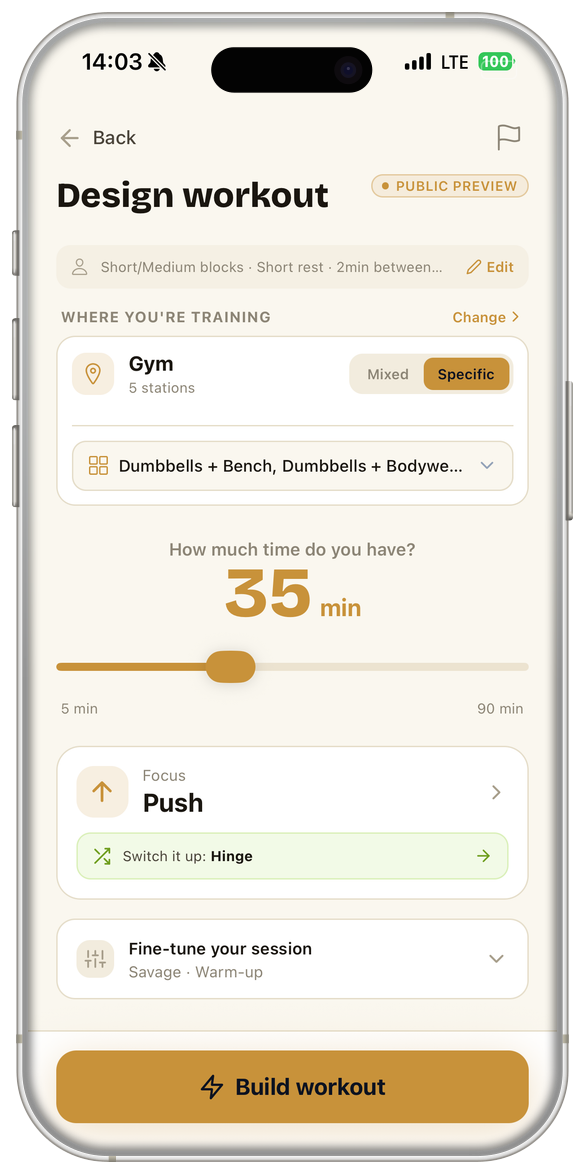
It should ask what you have, then build inside that reality:
- Dumbbells only
- Kettlebell only
- Full gym
- Machines
- Bench
- Pull-up bar
- Bodyweight
- Limited floor space
Having less gear was never the issue. Getting handed a workout that ignores it is.
Preferences matter too
Asking what you hate is not coddling you. It is reading the data that predicts whether you show up.
If you hate burpees, have cranky knees, prefer dumbbells, or want less jumping today, the workout should know that. Not because every session should be easy, but because friction compounds. A workout you keep avoiding stops being a disciplined plan and starts being a bad match.
The trick is to adapt without turning the session into random swaps. Keep the pattern, rotate the exercise inside it.
There is research behind that rule. A study comparing fixed and varied exercise selection (Fonseca et al. 2014, Journal of Strength and Conditioning Research) found that rotating exercises within the same movement pattern produced more complete muscle development than repeating one exercise, while keeping the pattern stable preserved strength progress. Variation works when it is systematic, not random.
If the plan needs a squat pattern and you do not have a barbell, a goblet squat can still do the job. If jumping is not the move today, a low-impact conditioning option can keep the signal without turning the session into punishment.
What adaptive should mean
An adaptive workout app should do four things:
- Respect your time. A 25-minute window should produce a 25-minute workout, not a 45-minute plan with wishful thinking.
- Use your equipment. The app should build from what is available, not ask you to improvise around what is missing.
- Honor your preferences. Avoids, favorites, intensity, rest, and mood should shape the session without erasing the training goal.
- Keep the training pattern intact. Substitutions should preserve the job of the block: squat, hinge, push, pull, carry, rotate, condition, recover.
That last point is where many apps get loose. When an app adapts, it should still be running the same job through the tools you happen to have, not improvising something new every time you open it.
A simple example
Say the goal is a 30-minute strength plus conditioning session, and you only have dumbbells.
A rigid app might hand you barbell squats, cable rows, and a treadmill interval because that is the template it likes.
An adaptive app should keep the structure and change the details:
- Warmup for the patterns you will train
- Dumbbell squat or split squat
- Dumbbell row or floor press pairing
- Loaded carry, swing, step-up, or low-impact interval
- Short cooldown
It is the same session underneath, run with what you have, so you spend zero time standing around working out what the workout was supposed to be.
Where Kronos fits
Kronos starts with the real constraints: your time, your equipment, and your mood. Then it builds a session around the patterns that make sense for today. Equipment works as a hard filter over a pool of 580 exercises: if you do not have a barbell, barbell movements do not exist for the session, rather than being suggested and swapped. The aim is fewer decisions, not a longer menu to scroll. Programs are the one place gear is a requirement rather than a filter; each program page lists what it needs.
The free interval timer is there when you already know what you want to do. When you want the workout picked for you, that is Kronos Pro, and annual starts with 7 days free if you are new to Pro. How equipment works in the app has the practical detail, including what happens when you change gyms.
The questions people ask next
What should a workout app do when I do not have the right equipment?
Keep the movement pattern and swap the tool: if the plan calls for a squat pattern and you have no barbell, a goblet squat does the same job. Substitution should preserve the block's purpose, not scramble the session.
Do home workouts with limited equipment still work?
Yes. The training pattern drives the adaptation, not the brand of the implement. Dumbbells, a kettlebell, or bodyweight can cover squat, hinge, push, pull, and carry patterns.
Why do preferences matter in a workout app?
Preferences are adherence data. A workout that avoids the movements you hate or cannot do safely is one you will actually repeat, and repetition is what produces results.